The Mahindra Bolero has long been a symbol of durability on Indian roads. The 2026 version aims to carry that legacy forward while adapting to changing expectations.
This isn’t just about a visual refresh. The Bolero 2026 looks set to evolve in areas that matter to everyday users, especially those who depend on it for tough conditions.
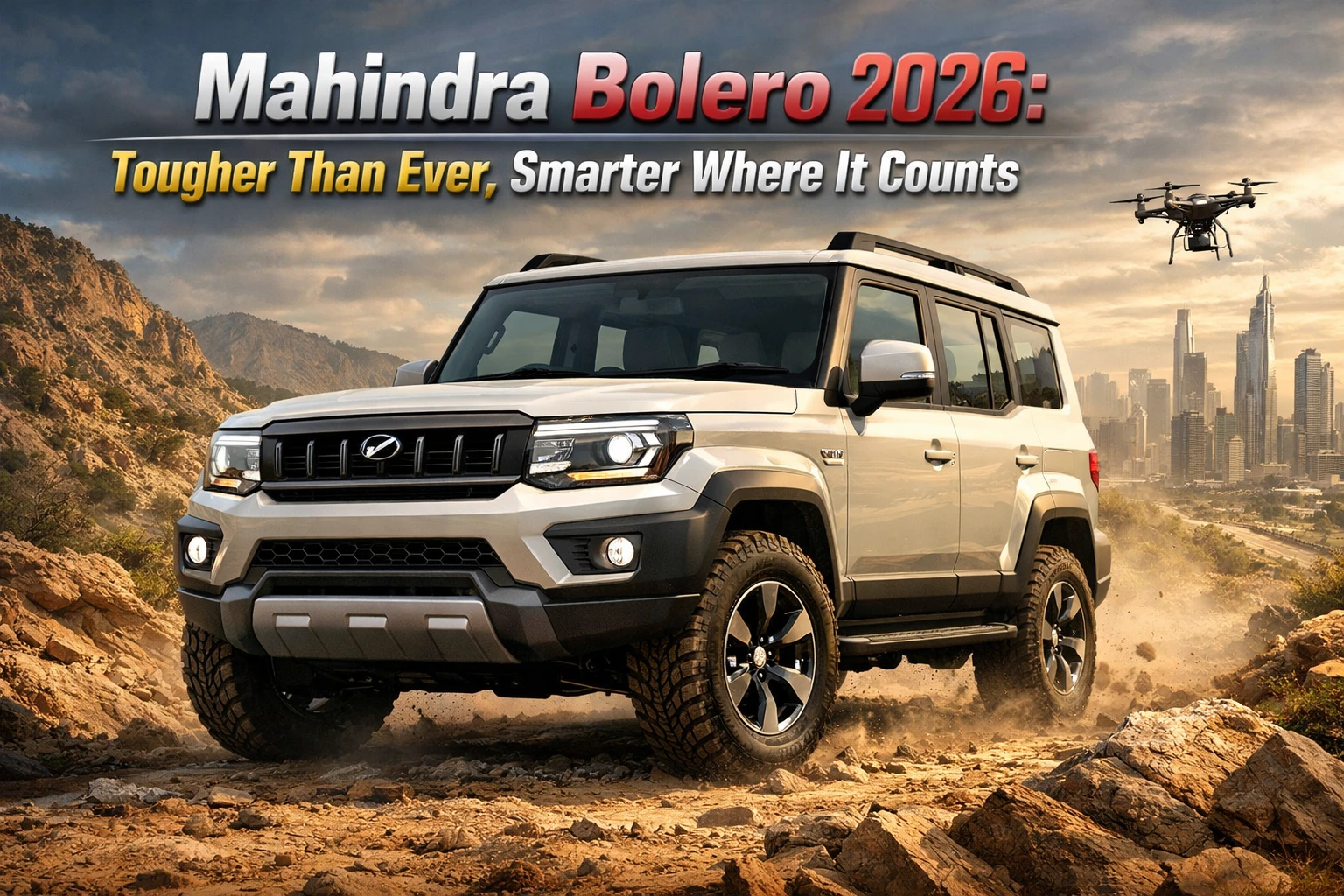
Mahindra seems to have retained the Bolero’s iconic boxy stance, but subtle design tweaks make it look more contemporary. Expect revised headlights, a refreshed grille, and cleaner lines that give it a slightly urban edge.
The updates are not about flashiness. They are meant to make the SUV feel relevant without losing its identity, which is critical for buyers who trust the Bolero for its no-nonsense presence.
The Bolero has always been about reliability in rough conditions, and the 2026 model is expected to continue that focus. Its high ground clearance and ladder-frame construction remain key strengths.
For rural users and fleet operators, this matters more than styling. The ability to handle broken roads, uneven terrain, and heavy loads is where the Bolero still stands apart from many modern SUVs.
| SpecificationDetails | |
| Engine | 1.5L Diesel Engine |
| Power Output | ~75–100 PS |
| Torque | ~210–260 Nm |
| Transmission | 5-speed Manual |
| Drivetrain | Rear-Wheel Drive |
| Mileage | 16–18 km/l (estimated) |
| Seating Capacity | 7-Seater |
| Body Type | Ladder-frame SUV |
| Fuel Type | Diesel |
The expected 1.5-litre diesel engine is not about speed. It focuses on low-end torque, which is more useful for carrying passengers or goods across uneven terrain.
In real-world use, this translates to fewer gear shifts and easier driving in loaded conditions. It is a setup designed for utility, not performance thrills.
Mileage is likely to remain one of the Bolero’s strongest points. With an expected range of 16–18 km/l, it balances fuel economy with load-carrying capability.
For buyers who drive long distances daily, especially in rural areas, this efficiency directly impacts running costs. That is where the Bolero quietly wins over more expensive alternatives.
The Bolero is not built for highway cornering or high-speed comfort. Instead, it offers a stable, predictable driving experience that inspires confidence on rough roads.
Steering is expected to remain simple and functional. The suspension setup will likely continue to absorb bad roads effectively, even if it feels slightly firm on smooth highways.
The interior is expected to receive meaningful updates, including a refreshed dashboard and improved materials. Basic infotainment and digital elements may also be introduced.
However, the focus will remain on durability. Controls are likely to stay simple and easy to use, which suits the Bolero’s target audience perfectly.
Mahindra may introduce essentials like a touchscreen infotainment system, Bluetooth connectivity, and power accessories. These features bring the Bolero closer to modern expectations.
But don’t expect feature overload. The idea is to offer useful additions without compromising reliability or increasing maintenance complexity.
With stricter regulations, the 2026 Bolero is expected to include dual airbags, ABS with EBD, and rear parking sensors as standard.
These additions are not optional anymore. For buyers, this means better peace of mind without having to move to a more expensive vehicle segment.
The Bolero’s upright design ensures excellent headroom and usable cabin space. The 7-seat layout continues to be practical for large families or shared transport use.
The rear seats are more functional than luxurious, but that is the trade-off. You get space and flexibility rather than plush comfort.
Pricing is not officially confirmed, but the Bolero 2026 is expected to stay within a competitive range of ₹9–11 lakh.
If Mahindra manages to maintain this pricing while adding modern updates, the Bolero will remain one of the most value-driven SUVs in its category.
The Bolero does not compete directly with feature-loaded compact SUVs. Instead, it occupies a unique space focused on durability, simplicity, and low running costs.
For buyers who prioritize practicality over style and gadgets, the Bolero still makes more sense than many newer options that struggle outside city limits.